← 返回 Community
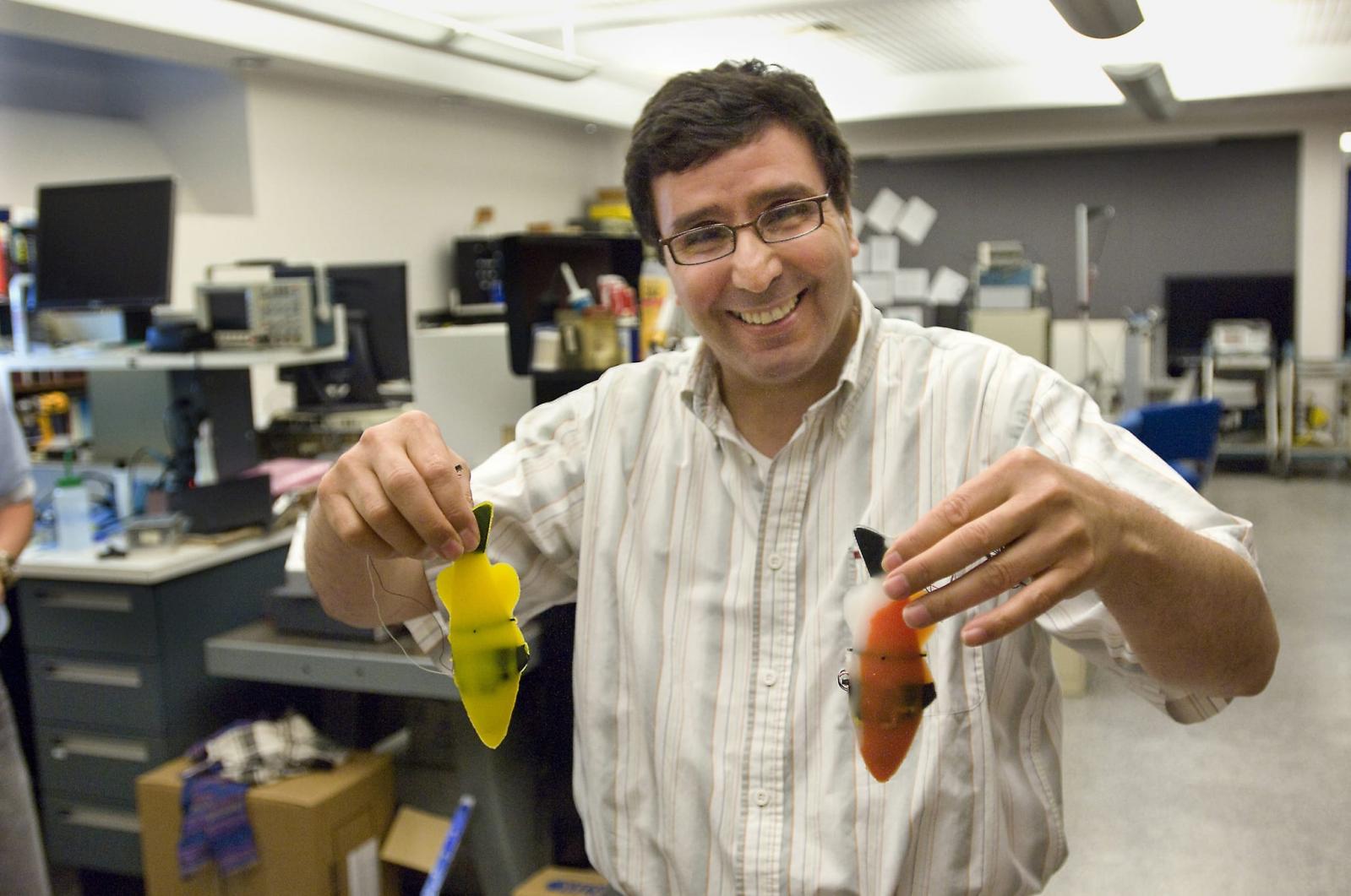
Kamal Youcef-Toumi
研究方向
- 控制与数字孪生
- 认知数字孪生
- 弹性可持续制造数字孪生
- 医疗职业健康数字孪生
- 机器人感知
- 相关性驱动多模态感知
- 高斯过程人体运动预测
- 学习与优化
- 可逆神经架构
- 多模态运输电力流协调
- 认知数字孪生
控制数字孪生机器人感知运动预测多模态感知
近三年论文 · 12 篇 (点击展开摘要,时间倒序)
Design and Fabrication of a Spin Coater with In-Situ Optical Measurement for Soft Thin Films
arXiv (Cornell University) · 2026 · cited 0 · doi.org/10.48550/arxiv.2606.15068
Spin coating is widely used for fabrication of thin polymer and elastomer films, yet reliable thickness verification of highly compliant materials remains challenging due to deformation from contact-based measurements and the cost and complexity of conventional optical metrology. Accurate thickness control is especially critical in soft elastomer applications such as dielectric elastomer actuators (DEAs), where mechanical and functional performance scales strongly with film thickness. This work presents a low-cost, primarily 3D-printed benchtop spin coater with an integrated, minimally deforming optical thickness measurement system for soft-film fabrication workflows. The system is designed to manufacture films between 50 and 300 microns thick with repeatability within 10 microns. Thickness is measured in-situ by tracking displacement of a reflected laser beam via quadrant photodetector, avoiding significant deformation. Optical geometry, sensor linearity constraints, and structural validation via finite element analysis are discussed. Experimental validation using calibrated metal shims demonstrated a thickness resolution of 3.6-3.7 microns and best-case measurement repeatability of 13 microns (95 percent confidence interval). The platform repeatably produced silicone films within 9 microns of target thickness, demonstrating that accessible optical metrology can be integrated into a low-cost spin coating system for practical, thickness-controlled fabrication of compliant thin films without specialized industrial instrumentation.
Design and Fabrication of a Spin Coater with In-Situ Optical Measurement for Soft Thin Films
arXiv (Cornell University) · 2026 · cited 0
Spin coating is widely used for fabrication of thin polymer and elastomer films, yet reliable thickness verification of highly compliant materials remains challenging due to deformation from contact-based measurements and the cost and complexity of conventional optical metrology. Accurate thickness control is especially critical in soft elastomer applications such as dielectric elastomer actuators (DEAs), where mechanical and functional performance scales strongly with film thickness. This work presents a low-cost, primarily 3D-printed benchtop spin coater with an integrated, minimally deforming optical thickness measurement system for soft-film fabrication workflows. The system is designed to manufacture films between 50 and 300 microns thick with repeatability within 10 microns. Thickness is measured in-situ by tracking displacement of a reflected laser beam via quadrant photodetector, avoiding significant deformation. Optical geometry, sensor linearity constraints, and structural validation via finite element analysis are discussed. Experimental validation using calibrated metal shims demonstrated a thickness resolution of 3.6-3.7 microns and best-case measurement repeatability of 13 microns (95 percent confidence interval). The platform repeatably produced silicone films within 9 microns of target thickness, demonstrating that accessible optical metrology can be integrated into a low-cost spin coating system for practical, thickness-controlled fabrication of compliant thin films without specialized industrial instrumentation.
A state-of-the-art survey on cognitive digital twins for resilient and sustainable manufacturing
Journal of Intelligent Manufacturing · 2026 · cited 0 · doi.org/10.1007/s10845-026-02886-4
Perceive What Matters: Relevance-Driven Scheduling for Multimodal Streaming Perception
arXiv (Cornell University) · 2026 · cited 0 · doi.org/10.48550/arxiv.2603.13176
In modern human-robot collaboration (HRC) applications, multiple perception modules jointly extract visual, auditory, and contextual cues to achieve comprehensive scene understanding, enabling the robot to provide appropriate assistance to human agents intelligently. While executing multiple perception modules on a frame-by-frame basis enhances perception quality in offline settings, it inevitably accumulates latency, leading to a substantial decline in system performance in streaming perception scenarios. Recent work in scene understanding, termed Relevance, has established a solid foundation for developing efficient methodologies in HRC. However, modern perception pipelines still face challenges related to information redundancy and suboptimal allocation of computational resources. Drawing inspiration from the Relevance concept and the information sparsity in HRC events, we propose a novel lightweight perception scheduling framework that efficiently leverages output from previous frames to estimate and schedule necessary perception modules in real-time based on scene context. The experimental results demonstrate that the proposed perception scheduling framework effectively reduces computational latency by up to 27.52% compared to conventional parallel perception pipelines, while also achieving a 72.73% improvement in MMPose activation recall. Additionally, the framework demonstrates high keyframe accuracy, achieving rates of up to 98%. The results validate the framework's capability to enhance real-time perception efficiency without significantly compromising accuracy. The framework shows potential as a scalable and systematic solution for multimodal streaming perception systems in HRC.
Perceive What Matters: Relevance-Driven Scheduling for Multimodal Streaming Perception
arXiv (Cornell University) · 2026 · cited 0
In modern human-robot collaboration (HRC) applications, multiple perception modules jointly extract visual, auditory, and contextual cues to achieve comprehensive scene understanding, enabling the robot to provide appropriate assistance to human agents intelligently. While executing multiple perception modules on a frame-by-frame basis enhances perception quality in offline settings, it inevitably accumulates latency, leading to a substantial decline in system performance in streaming perception scenarios. Recent work in scene understanding, termed Relevance, has established a solid foundation for developing efficient methodologies in HRC. However, modern perception pipelines still face challenges related to information redundancy and suboptimal allocation of computational resources. Drawing inspiration from the Relevance concept and the information sparsity in HRC events, we propose a novel lightweight perception scheduling framework that efficiently leverages output from previous frames to estimate and schedule necessary perception modules in real-time based on scene context. The experimental results demonstrate that the proposed perception scheduling framework effectively reduces computational latency by up to 27.52% compared to conventional parallel perception pipelines, while also achieving a 72.73% improvement in MMPose activation recall. Additionally, the framework demonstrates high keyframe accuracy, achieving rates of up to 98%. The results validate the framework's capability to enhance real-time perception efficiency without significantly compromising accuracy. The framework shows potential as a scalable and systematic solution for multimodal streaming perception systems in HRC.
Towards Scalable Probabilistic Human Motion Prediction with Gaussian Processes for Safe Human-Robot Collaboration
Open MIND · 2026 · cited 0 · doi.org/10.48550/arxiv.2603.07096
Accurate human motion prediction with well-calibrated uncertainty is critical for safe human-robot collaboration (HRC), where robots must anticipate and react to human movements in real time. We propose a structured multitask variational Gaussian Process (GP) framework for full-body human motion prediction that captures temporal correlations and leverages joint-dimension-level factorization for scalability, while using a continuous 6D rotation representation to preserve kinematic consistency. Evaluated on Human3.6M (H3.6M), our model achieves up to 50 lower kernel density estimate negative log-likelihood (KDE NLL) than strong baselines, a mean continuous ranked probability score (CRPS) of 0.021 m, and deterministic mean angle error (MAE) that is 3-18% higher than competitive deep learning methods. Empirical coverage analysis shows that the fraction of ground-truth outcomes contained within predicted confidence intervals gradually decreases with horizon, remaining conservative for lower-confidence intervals and near-nominal for higher-confidence intervals, with only modest calibration drift at longer horizons. Despite its probabilistic formulation, our model requires only 0.24-0.35 M parameters, roughly eight times fewer than comparable approaches, and exhibits modest inference times, indicating suitability for real-time deployment. Extensive ablation studies further validated the choice of 6D rotation representation and Matern 3/2 + Linear kernel, and guided the selection of the number of inducing points and latent dimensionality. These results demonstrate that scalable GP-based models can deliver competitive accuracy together with reliable and interpretable uncertainty estimates for downstream robotics tasks such as motion planning and collision avoidance.
Towards Scalable Probabilistic Human Motion Prediction with Gaussian Processes for Safe Human-Robot Collaboration
arXiv (Cornell University) · 2026 · cited 0
Accurate human motion prediction with well-calibrated uncertainty is critical for safe human-robot collaboration (HRC), where robots must anticipate and react to human movements in real time. We propose a structured multitask variational Gaussian Process (GP) framework for full-body human motion prediction that captures temporal correlations and leverages joint-dimension-level factorization for scalability, while using a continuous 6D rotation representation to preserve kinematic consistency. Evaluated on Human3.6M (H3.6M), our model achieves up to 50 lower kernel density estimate negative log-likelihood (KDE NLL) than strong baselines, a mean continuous ranked probability score (CRPS) of 0.021 m, and deterministic mean angle error (MAE) that is 3-18% higher than competitive deep learning methods. Empirical coverage analysis shows that the fraction of ground-truth outcomes contained within predicted confidence intervals gradually decreases with horizon, remaining conservative for lower-confidence intervals and near-nominal for higher-confidence intervals, with only modest calibration drift at longer horizons. Despite its probabilistic formulation, our model requires only 0.24-0.35 M parameters, roughly eight times fewer than comparable approaches, and exhibits modest inference times, indicating suitability for real-time deployment. Extensive ablation studies further validated the choice of 6D rotation representation and Matern 3/2 + Linear kernel, and guided the selection of the number of inducing points and latent dimensionality. These results demonstrate that scalable GP-based models can deliver competitive accuracy together with reliable and interpretable uncertainty estimates for downstream robotics tasks such as motion planning and collision avoidance.
VINA: Variational Invertible Neural Architectures
Open MIND · 2026 · cited 0 · doi.org/10.48550/arxiv.2602.20480
The distinctive architectural features of normalizing flows (NFs), notably bijectivity and tractable Jacobians, make them well-suited for generative modeling. Invertible neural networks (INNs) build on these principles to address supervised inverse problems, enabling direct modeling of both forward and inverse mappings. In this paper, we revisit these architectures from both theoretical and practical perspectives and address a key gap in the literature: the lack of theoretical guarantees on approximation quality under realistic assumptions, whether for posterior inference in INNs or for generative modeling with NFs. We introduce a unified framework for INNs and NFs based on variational unsupervised loss functions, inspired by analogous formulations in related areas such as generative adversarial networks (GANs) and the Precision-Recall divergence for training normalizing flows. Within this framework, we derive theoretical performance guarantees, quantifying posterior accuracy for INNs and distributional accuracy for NFs, under assumptions that are weaker and more practically realistic than those used in prior work. Building on these theoretical results, we conduct extensive case studies to distill general design principles and practical guidelines. We conclude by demonstrating the effectiveness of our approach on a realistic ocean-acoustic inversion problem.
VINA: Variational Invertible Neural Architectures
arXiv (Cornell University) · 2026 · cited 0
The distinctive architectural features of normalizing flows (NFs), notably bijectivity and tractable Jacobians, make them well-suited for generative modeling. Invertible neural networks (INNs) build on these principles to address supervised inverse problems, enabling direct modeling of both forward and inverse mappings. In this paper, we revisit these architectures from both theoretical and practical perspectives and address a key gap in the literature: the lack of theoretical guarantees on approximation quality under realistic assumptions, whether for posterior inference in INNs or for generative modeling with NFs. We introduce a unified framework for INNs and NFs based on variational unsupervised loss functions, inspired by analogous formulations in related areas such as generative adversarial networks (GANs) and the Precision-Recall divergence for training normalizing flows. Within this framework, we derive theoretical performance guarantees, quantifying posterior accuracy for INNs and distributional accuracy for NFs, under assumptions that are weaker and more practically realistic than those used in prior work. Building on these theoretical results, we conduct extensive case studies to distill general design principles and practical guidelines. We conclude by demonstrating the effectiveness of our approach on a realistic ocean-acoustic inversion problem.
Human digital twins in healthcare and occupational well-being: Enabling techniques, applications, datasets and future trends
Computers in Industry · 2026 · cited 0 · doi.org/10.1016/j.compind.2026.104463
Automating Radio Communication Training: A Protocol-Aware Chatbot Using Context Engineering for Human-centric Industrial Operations
Procedia CIRP · 2026 · cited 0 · doi.org/10.1016/j.procir.2025.09.014
In human-centric industries such as transportation and heavy manufacturing, strict adherence to safety-critical radio communication (RC) protocols is essential for operational efficiency and safety. Traditional training methods rely on human instructors, who may introduce inconsistencies or biases. While chatbots present a scalable alternative, conventional Retrieval-Augmented Generation (RAG) systems often fail to enforce protocol compliance reliably. Hence, a protocol-aware training chatbot is proposed to bridge this gap, leveraging context engineering and few-shot learning with Large Language Models (LLMs) to deliver industry-specific and protocol-compliant responses. Validated through a transportation case study, this chatbot system demonstrates robust consistency in RC protocol enforcement across 18 scenarios of varying complexity. An integrated scoring mechanism evaluates trainee performance and provides corrective feedback, enhancing learning outcomes. By providing practical and human-like experiences in RC training, this system can be adapted across industries to reduce miscommunication risks.
Optimal Multi-Modal Transportation and Electric Power Flow: The Value of Coordinated Dynamic Operation
SSRN Electronic Journal · 2026 · cited 0 · doi.org/10.2139/ssrn.6363029